Futarchy: Betting on Better Governance
The way most DAOs make decisions is basically a popularity contest with extra steps. You hold tokens, you get votes. More tokens, more votes. In practice this means the top 10 voters in Compound control about 58% of all voting power. Uniswap is around 45%. If you're a regular holder your vote doesn't really move anything.
Turnout is awful too. Around 10% of token holders actually vote. Most people know the whales decide everything so they just don't show up. And there's zero cost to being wrong. You can vote yes on a terrible proposal and nothing happens to you. Someone who spent a week analyzing a proposal has the same per-token power as someone who didn't even open it.
So complex proposals just get decided by vibes. People skip the technical stuff or vote based on gut feeling.
The idea
Back in 2000, an economist named Robin Hanson wrote a paper with a pretty simple premise. What if instead of voting on decisions, you had to put money on them? He called it futarchy. The tagline was "vote on values, but bet on beliefs."
Nobody built it for like two decades. Then MetaDAO showed up on Solana and actually shipped the first real implementation.
How MetaDAO works
Someone submits a proposal. Two prediction markets get created: a pass market and a fail market. You deposit  META 421.0% or USDC and get two types of conditional tokens:
- pTokens (pass tokens) worth something if the proposal passes
- fTokens (fail tokens) worth something if the proposal fails
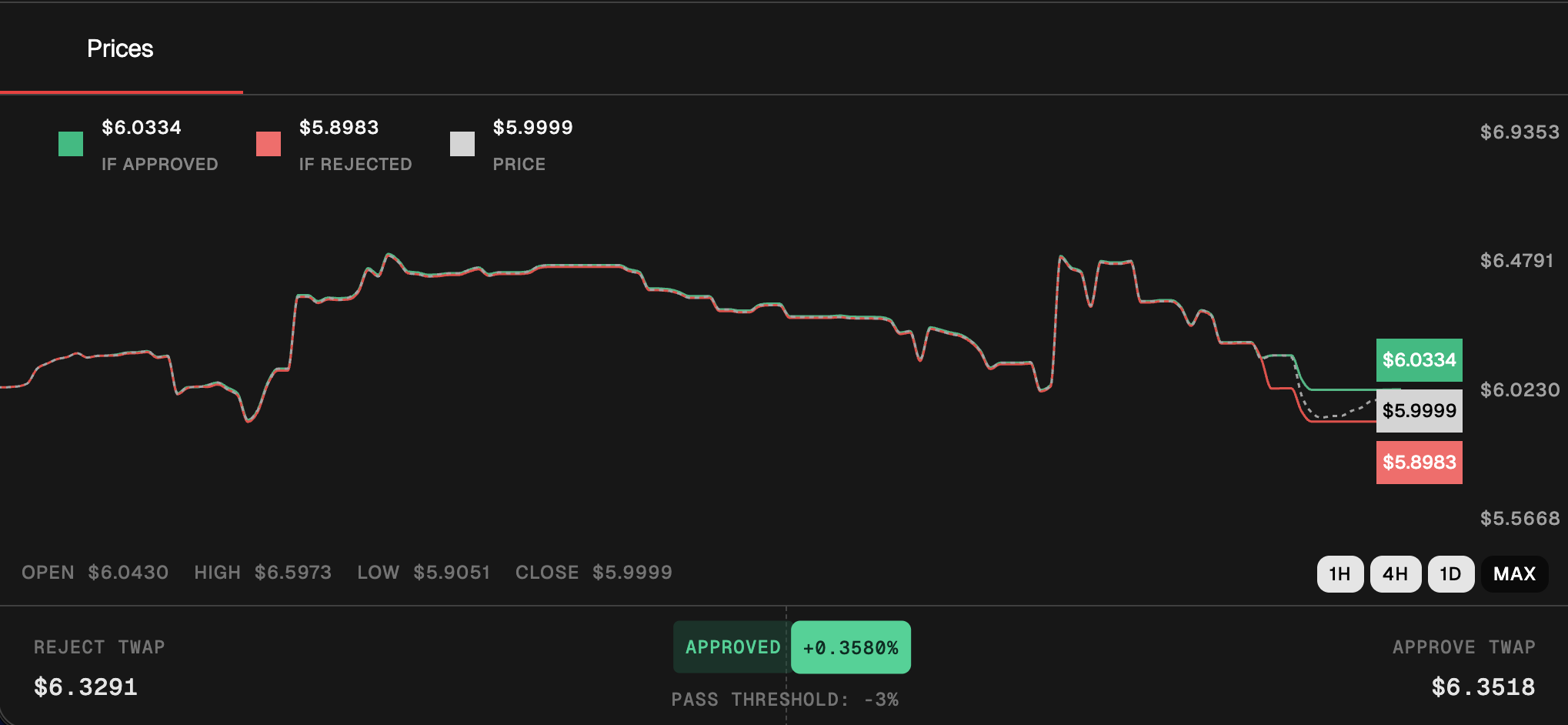
The markets trade for a set period. An AMM tracks a TWAP over the trading window so nobody can swoop in last second and manipulate the result. When trading ends, the protocol (called Autocrat) compares the pass market price against the fail market price. If the pass price is at least 3% higher, the proposal passes and executes automatically on-chain. If not, it fails. Winners cash out, losers get nothing.
Say someone proposes spending 1,000 USDC from the treasury on marketing. People who think that's a good use of funds buy pass tokens and drive that price up. People who think it's a waste buy fail tokens. The market sorts it out.
Here's roughly what a passing proposal looks like. The pass price drifts above fail over the trading period:
Over 6% gap between pass and fail by the end, so it passes and executes automatically.
The reason this works differently from normal DAO voting is that you're risking actual money on your opinion. In a regular DAO you can support a destructive proposal with zero personal risk. With futarchy, being wrong costs you money. Being right makes you money. So people who actually understand the proposal have a financial reason to participate, and people who don't have a financial reason to stay out. The system just naturally weights toward informed participants without anyone having to design who gets more voting power.
Adoption
MetaDAO launched FaaS (Futarchy as a Service) in 2024, letting other Solana projects plug into the same mechanism. Sanctum, Drift, Jito, Marinade are already using it.
They also built a token launchpad where project treasuries are locked on-chain and team budgets get controlled by the market. First big launch was over 1,000% oversubscribed lmao.
Robin Hanson himself joined as an advisor in 2025. The guy who came up with the concept 25 years ago.
The problems
Learning curve is steep. Going from "click a button to vote" to "trade conditional tokens to express your opinion" is a big ask for most people. Liquidity can also be thin on smaller proposals, which means the market signal isn't always reliable. And using token price as the only measure of whether a decision was good does not capture everything about how a project is doing.
But when there's money on the line, the quality of information goes way up compared to free votes. There's already proof of this working. A fund launched on MetaDAO got dissolved by token holders through futarchy because it was underperforming. That kind of accountability basically doesn't exist in traditional DAOs.
Whether this becomes the default governance model, I have no idea. But it's live, it's processing real proposals with real money, and so far the results look better than what most DAOs are getting with token-weighted voting.